ANNOTATION
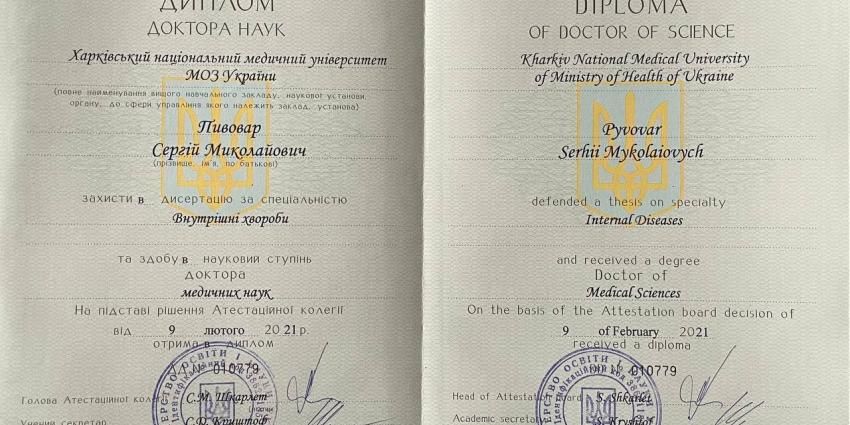
Pyvovar S.M. Optimisation of prognosis of the clinical outcome and effectiveness of heart failure treatment in patients with coronary artery disease with concomitant thyroid pathology. – The qualifying thesis as a manuscript.
Thesis for a scientific degree of Doctor of Medical Science in specialty 14.01.02 – Internal Medicine. – Government Institution “L.T. Malaya Therapy
National Institute of the National Academy of Medical Sciences of Ukraine”, Ukraine, Kharkiv.
Dissertation defense will take place in Kharkiv National Medical University of The Ministry of the Public Health of Ukraine, Kharkiv 2020.
The topicality of the problem of optimising the prognosis of the heart failure (HF) clinical outcome and improving the effectiveness of treatment in patients with coronary artery disease (CAD) with concomitant thyroid pathology (TP) is determined by the high spread of both HF and thyroid disease (TD) in Ukraine and in the world. The changes in hormonal and cytokine balance are the main factors that influence heart pathology progression, mediate the response to β-adrenoblockers (β-AB) treatment under these conditions and, as a consequence, an unfavourable longtime clinical outcome. With the accumulation of knowledge about the formation of changes related to HF and the thyroid pathologies, it is becoming more obvious that variability of pathological features in individuals largely depends on the genetic basis. Taking into consideration the scientifically based mechanisms of genetic and hormonal control of susceptibility to cardiovascular disease, the solution to this problem probably lies in the study of the relationships between these factors, which will help to increase the quality of predicting the clinical outcome of HF and optimize the existing treatment regimens taking into account pharmacogenetic and hormonal profiles.
In connection with the above, the aim of the study is to improve the prognosis of the clinical outcome and optimize the treatment of heart failure in patients with coronary artery disease in combination with thyroid pathology on the basis of hormonal and genetic parameters study.
In accordance with the aim and objectives of the study, a comprehensive examination was carried out. It involved 381 patients with HF, which developed on the background of coronary artery disease and post-infarction cardiosclerosis. In the study period, all the patients underwent treatment in cardiology departments of the Government Institution “L.T. Malaya Therapy National Institute of the National Academy of Medical Sciences of Ukraine”. The median age of patients was 58.00
[54.00 – 67.00] years. Among those 261 (68.50%) patients were male. The control group included 55 practically healthy individuals who matched the sex and age distribution with patients with HF.
According to the study design, patients with HF were divided into two groups: the main group consisted of patients with HF and concomitant thyroid disease
(n = 218) (92 patients with diffuses nontoxic goiter (NG) and 126 patients with autoimmune thyroiditis (AIT)); the comparison group included 163 patients with HF without thyroid pathology. The groups were matched by age. The group of patients with HF with concomitant thyroid pathology, compared to patients without TP, included a higher percentage of women than men (42.7% versus 16.6%, respectively,
at p = 0.001).
The diagnoses of coronary artery disease, HF and thyroid disease (nontoxic goiter and autoimmune thyroiditis) were verified in accordance with the valid criteria. Patients of the main and the comparison group were subjected to a comprehensive clinical examination (in accordance with the order of the Ministry of Healthcare of Ukraine No. 436 of 03.07.2006 (as amended by the order of the Ministry of Healthcare of Ukraine of 24.05.2012 No. 384) "On approval of clinical protocols of providing medical care in "Cardiology" specialty; № 152 dated from 02.03.2016 "Unified clinical protocol of primary, secondary (specialized) and tertiary (highly specialized) medical care "Stable coronary artery disease"); No. 356 of 22.05.2009 “On approval of protocols for the provision of medical care in the specialty “Endocrinology"” and taking into account the European Society of Cardiology (2016) and the Ukrainian Society of Cardiologists and Ukrainian Association of Heart Failure Specialists (2017) guidelines for diagnosis and treatment of heart failure; Guidelines of the American Thyroid Association: “Guidelines for the diagnosis and treatment of adults with thyroid nodules and differentiated thyroid cancer” (2015) and “The clinical management of patients with hypothyroidism” (2013 and 2017), “The clinical management of patients with thyroiditis” (2018); Guidelines of the European Thyroid Association “Diagnosis and treatment of endogenous subclinical hypothyroidism” (2015)).
Anthropometric examination was carried out: taking into account height and weight, body mass index (BMI) was calculated. Clinical blood test was carried out, biochemical investigation (indicators of lipid metabolism: levels of total cholesterol, triglycerides, cholesterol, lipoprotein high, low and very high density) were performed. Enzime-linkedimmunosorbent assay was conducted: levels of free triiodothyronine (T3f), free tetraiodothyronine (T4f), reversible triiodothyronine (T3r)),
N-terminal fragment of the brain natriuretic peptide precursor (NT-proBNP), tumor necrosis factor-a, interleukins (IL) IL-1b, IL-4, IL-6, as well as thyroid peroxidase and thyroglobulin antibody titers were evaluated. Genetic studies were conducted by using polymerase chain reaction method, which included determination of allelic polymorphisms of b1-adrenoreceptor (β1-AR) genes (rs1801253, р.Ser49Gly; c.1165G>C; p.Gly389Arg); and (rs1801252; c.145A>G; p.Ser49Gly), b2-AR (rs1042714; c.79C>G; p.Gln27Glu) and the G-protein subunit gene (GNb3) (rs5443; c.825C>T; p.Ser275). Instrumental (electro- and echocardiography, ultrasound of thyroid gland) methods were used. Patients were observed for two years, taking into account the frequency of re-hospitalisation (RH) due to HF decompensation, mortality, and reaching the combined endpoint (CE) as a combination of RH and death. Statistical data was processed.
The scientific novelty is in the development of the concept of predicting the HF clinical outcome in patients with coronary artery disease with comorbid thyroid pathology (based on optimization of diagnosis of “low triiodothyronine” syndrome (LT3S), taking into account clinical, genetic profile) and optimisation of the dose titration scheme of bisoprolol.
For the first time the expediency of distinguishing heart failure with “low triiodothyronine” syndrome as a separate classification option has been substantiated, taking into account the following: the significant effect of "low triiodothyronine" syndrome on the clinical outcome of HF; common genetic factors associated with an increased risk of adverse cardiac pathology and development of “low triiodothyronine” syndrome; neutralising the effect from bisoprolol with its dosage increase to more than 5 mg in patients of this category.
For the first time, it has been found out that HF in patients with coronary artery disease with concomitant TP has a more severe clinical outcome, due to the high frequency of LT3S in these patients. The frequency of LT3S among patients with HF is 7.3%, but if HF is combined with TP, it constitutes 38.4%. The risk of re-hospitalization of patients with HF, according to ROC-analysis, certainly increases at the level of T3f ≤ 2.07 pmol / l. Patients with LT3S have a more severe clinical outcome of heart failure: a higher percentage of patients with functional class IV, higher levels of NT-proBNP; more pronounced dilatation of the left ventricular cavity and decreased systolic function of the myocardium, violation of its relaxation; higher risk of RH and CE.
The study of associations of β-adrenoreceptor system gene polymorphisms with the clinical outcome of HF and the effectiveness of β-adrenoblockers has been continued. It has been demonstrated that carrier state of the A allele of the Ser49Gly (c.145A > G) polymorphism of the b1-AR gene leads to a decrease in CE. At the same time, the carrier state of the G allele of the Gln27Glu (c.79C> G) polymorphism of the b2-AR gene increases the risk of CE. Patients with HF and with the G/C genotype of the Gly389Arg polymorphism of the β1-AR gene have a lower risk of atrial fibrillation.
Administration of bisoprolol at a dose of > 5 mg leads to a reduction of the risk of the combined endpoint, provided the G/A genotype of the Ser49Gly (c.145A > G) polymorphism of the β1-AR gene is present. The use of bisoprolol at this dose also reduces the risk of re-hospitalisation and combined endpoint, provided the homozygous genotype (C/C) of the Gln27Glu (c.79C > G) polymorphism of the β2-AR gene is present.
It is the first time when the connection of polymorphisms of genes of the
β-adrenoreceptor system with the risk of LT3S development in patients with HF has been demonstrated. Thus, the probability of the syndrome increases with the homozygous G/G genotype of the Gln27Glu polymorphism of the β2-AR gene and in the presence of the C/T polymorphism of the Serβ75 GNβ3 gene. The genotype C/G of the Gln27Glu polymorphism of the β2-AR gene is associated with a decreased risk of LT3S.
For the first time it has been found out that the risk of elevated levels of TNF-α and IL-1β increases in the presence of the heterozygous Ser49Gly (c, 145A> G) polymorphism of the β1-AR gene and the homozygous (C/C) polymorphism of the Ser375 gene of the β3 subunit of the G protein.
On the basis of multivariate regression analysis of Cox proportional hazards, factors causing the unfavourable clinical outcome of HF in patients with concomitant thyroid pathology have been identified for the first time. A prognostic model for estimating the probability of re-hospitalization of these patients has been described.
The study of the effectiveness of bisoprolol in heart failure in patients with different comorbidities has been further improved. Thus, the use of bisoprolol in patients with HF in combination with TP has no dose-dependent positive effect. The use of bisoprolol in patients with TP but without LT3S leads to a possible reduction of the risk of re-hospitalization and combined endpoint. The re-hospitalisation frequency in the group of patients with HF without LT3S is higher at a dose of bisoprolol ≤ 5.0 mg, compared to higher doses. In patients with HF with decreased left ventricular ejection fraction with concomitant LT3S an increased risk of re-hospitalization, a decrease in serum T3f level, an increase in T4f level, a decrease in the T3f / T4f ratio as well as enlargement of heart cavities were observed, when titration of bisoprolol dose > 5 mg occurred.
It has been proved that the use of levothyroxine in patients with HF on the background of coronary artery disease with concomitant TP has a dose-dependent positive effect on the left ventricular ejection fraction and on the clinical outcome of the heart pathology. The maximum left ventricular ejection fraction is observed in patients who received the drug at a dose of > 1.2 μg / kg. Administration of the drug at a dose of > 0.53 µg / kg leads to a possible reduction of re-hospitalization rate within
2 years due to decompensation of the pathology.
It has been found out that in order to optimize the prognosis of HF in patients with coronary artery disease and concomitant TP, it is advisable to calculate the hazard risk (HR) by the equation of the prognostic model for the assessment of re-hospitalization probability. The risk of adverse clinical outcome increases with
HR > 0.043.
A method for the diagnosis of LT3S in patients with HF has been developed. It has been proved that for verification of this syndrome it is expedient to use values of serum T3f level ≤ 2.07 pmol / l. It increases the predictive value of this syndrome.
The bisoprolol dose titration scheme in patients with HF and concomitant TP has been optimized: before the administration of bisoprolol, it is advisable to exclude the presence of LT3S. If this syndrome is diagnosed, a dose of bisoprolol > 5 mg should not be titrated, and the time to reach 5 mg dosage should exceed 63 days.
A method for predicting the clinical outcome of HF in patients with coronary artery disease by genetic factors has been developed, according to which it is expedient to determine the polymorphisms of β-adreno-receptors genes.
In order to improve the prognosis for patients with HF on the background of coronary artery disease and concomitant autoimmune thyroiditis with development of hypothyroidism, a long-term use of levothyroxine at a dose > 0.53 µg/kg may be appropriate.
Key words: heart failure, nontoxic goiter, autoimmune thyroiditis, low triiodothyronine syndrome, prognosis, longtime clinical outcome, bisoprolol, β-adreno-receptors, genes, polymorphism.